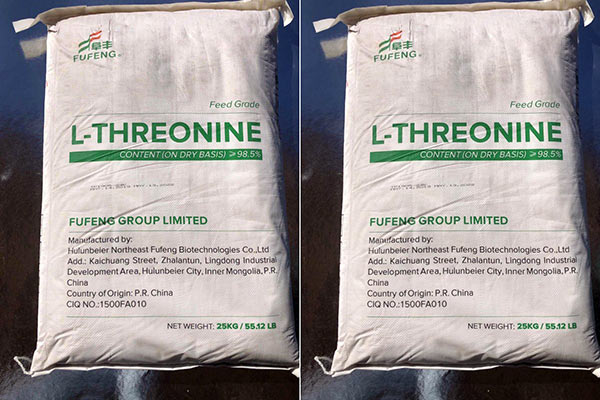
L-Threonine feed application
Many grains and other feed ingredients are low in threonine and require the addition of threonine to overcome this deficiency.
This is especially important when balancing wheat, barley and sorghum based diets. In these grains, threonine is often the second limiting amino acid. In addition, for pigs, the digestibility of threonine in these components is very low.
For pigs, the first limiting amino acid is lysine, and meat productivity directly depends on the lysine content in the feed.
The second amino acid, without which it is impossible to maximize the use of feed resources in pig breeding, is threonine.
The addition of pure amino acids to the pig diet allows a reduction in the protein content of the feed and an improvement in its utilization without slowing down the growth rate.
-
What does it look like
White to deep creamy powder
-
Mass fraction of active substance
98,5%
-
Fraction of tertiary amine
-
-
Hydrogen ion activity index
-
-
Melting temperature
-
Payment for feed threonine is made on a prepayment basis, but payment by installments is also considered in some cases. To clarify the conditions, send the commercial proposal through the form on the website or by mail, as a letter.
Appearance WHITE rhombic crystals
(powder)
Content,% ≥ 98.50
Specific rotation + 18 ° ~ + 21.5 °
Loss after ignition,% ≤ 1.0
Residue on combustion,% ≤ 0.3
Ammonium salts (NH4 +),% ≤ 0.04
Arsenic (As),% ≤0.0002
Heavy metals (Pb),% ≤ 0.003
pH 5.0 ~ 6.0
Synonyms alpha-amino-beta-hydroxybutyric acid, 2-amino-3-hydroxybutanoic acid, L-Threonine
International name L-Threonine, 2-Amino-3-hydroxybutanoic acid
Formula HO2CCH (NH2) CH (OH) CH3
Molecular weight 119.12
GOST -
CAS 6028-28-0, 72-19-5
EINECS 200-774-1
RTECS -
OKP code -
TNVED code 2922498500
GNG code 292249
ETSNG code 73100